[NYT Op-Ed Submission]
A New Paradigm for Korea’s Strategic Neutrality (Vana Kim, Ed.D.)
Dear Op-Ed Editor,
The recent political turmoil in South Korea and North Korea’s abrupt declaration of a “hostile two-state” relationship have pushed the Korean Peninsula into its most volatile state in decades.
I am submitting the following op-ed, “Why South Korea Needs ‘Democratic Security’ and ‘Active Neutralization’ Now,” for your exclusive consideration.
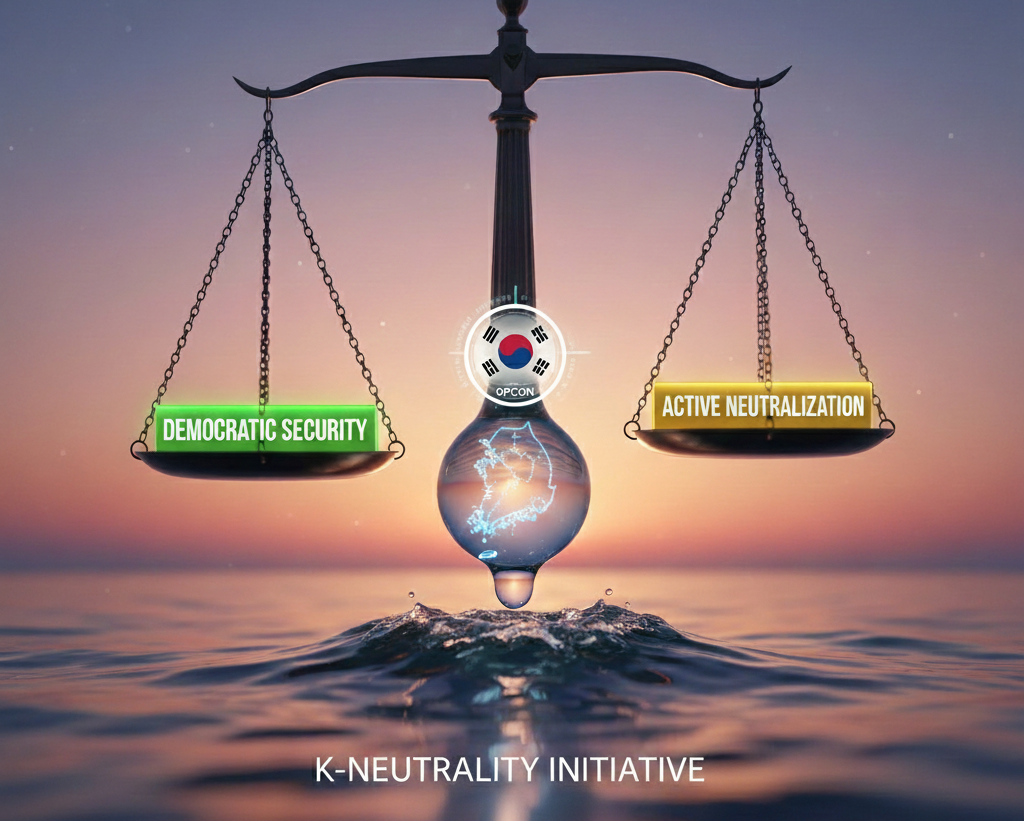
In this piece, I argue that the path to regional stability lies in a fundamental paradigm shift: “Democratic Security” at home—ensured by the transfer of wartime operational control (OPCON) to civilian oversight—and “Active Neutralization” abroad. This strategy positions South Korea as a strategic "Linchpin of Peace," leveraging its technological status to deter great-power conflict in Northeast Asia.
As the founder of the K-Neutrality Initiative, I believe this perspective offers an essential lens through which to understand the shifting dynamics of global democracy and Asian security in 2026.
This essay is exclusive to The New York Times. Thank you for your time and consideration.
Sincerely,
Vana Kim, Ed.D. Peace Activist & Philosopher Founder, K-Neutrality Initiative (818) 651-5338 | vanakim777@gmail.com www.k-neutrality.org (Launching soon)
[Op-Ed Content]
Why South Korea Needs ‘Democratic Security’ and ‘Active Neutralization’ Now By Vana Kim
The year 2025 left South Korea with a paradox that will define the future of Northeast Asia. On one hand, the world witnessed the fragility of our democracy during a sudden attempt at martial law. On the other, we face an emboldened North Korea that has officially abandoned the dream of unification, declaring us a “hostile enemy state.”
Standing at this icy crossroads in early 2026, we realize that old paradigms—based on sentimental ethnic bonding or passive dependence on great-power protection—are no longer sufficient. To survive and thrive, South Korea must embrace a new paradigm: Democratic Security at home and Active Neutralization abroad.
For too long, the discourse on the Transfer of Wartime Operational Control (OPCON) has been framed narrowly as a military logistics issue. It is far more than that. The recent domestic crisis proved that the command of our armed forces must be rooted in domestic democratic oversight. OPCON transfer is the final cornerstone of our "Democratic Security." It ensures that our military serves the citizens and the Constitution, not the political whims of a ruler. A nation that cannot command its own troops cannot truly guarantee its own democracy.
Internal strength, however, is only half the equation. As North Korea fortifies its borders and aligns with Moscow, South Korea must redefine its geopolitical role. This is where "Active Neutralization" comes in. Unlike the passive neutrality of the Cold War, which sought safety through isolation, Active Neutralization is a proactive diplomatic strategy. It positions South Korea not as a pawn in the U.S.-China rivalry, but as a strategic "Linchpin of Peace." By leveraging our economic and technological status—creating green energy hubs and digital corridors—we can make conflict on the peninsula too costly for any neighbor to initiate.
This is not a retreat into isolationism; it is a leap into strategic autonomy. By achieving Democratic Security, we protect our people from internal power abuses. By pursuing Active Neutralization, we shield our peninsula from becoming a battlefield for great powers again.
As King Gojong proclaimed Korea's neutrality 120 years ago to fend off colonial ambitions, we today declare a matured version of that dream. In 2026, we do not merely ask for peace; we create it through institutional strength and diplomatic courage.
"OPCON transfer is the democratization of security; Active Neutralization is the globalization of peace."
[End of Submission]
“Submitted for exclusive consideration to The New York Times (January 2026)”
The 3 Core Values of K-Neutrality Initiative
- Democratic Security
- Active Neutralization
- Globalization of Peace